Low-Cost Cerebrovascular Flow Pump
Overview
This project involved the independent design and development of a low-cost pulsatile flow pump system to simulate physiologically realistic cerebrovascular blood flow for interventional neuroradiology training and experimental research applications.
Typically assigned to a four-person team, the project was executed independently and focused on achieving accurate flow and pressure dynamics using accessible components and a modular, research-oriented system architecture.
Project Type: Independent Capstone Design and Protoype
Duration: 8 months (2 academic semesters)
Focus Areas: Pulsatile Flow Modeling · Embedded Control · Experimental Validation
Role: Sole designer, developer and analyst
Motivation
Commercial cerebrovascular flow simulators are often prohibitively expensive and inaccessible for many academic and training environments. The objective of this project was to design a cost-effective alternative (approximately $600 total system cost, ~75% lower than comparable professional systems) capable of replicating key hemodynamic characteristics of cerebral arteries while supporting future experimental expansion.
System Architecture & Design
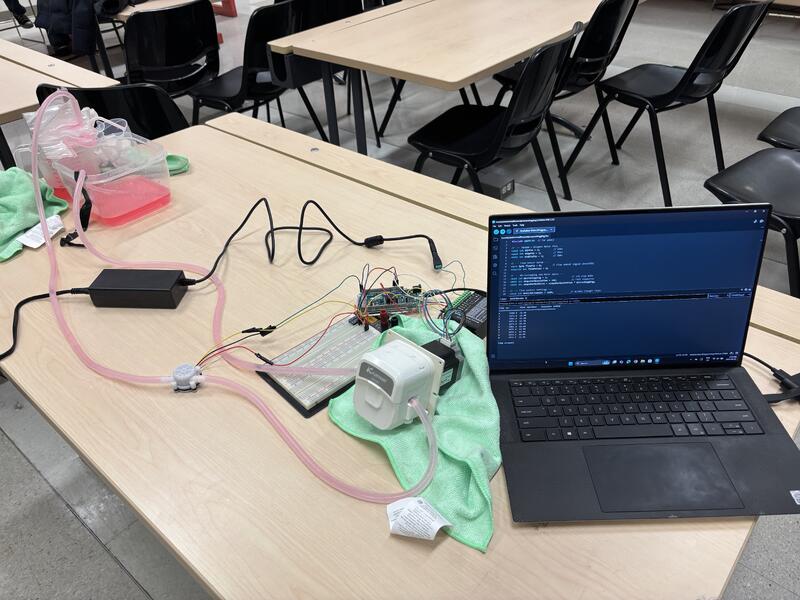
The system integrates mechanical, electrical and computational components to achieve controlled pulsatile flow:
- Peristaltic stepper motor pump driven by an Arduino-based control architecture
- Real-time flow sensing and signal processing for monitoring system behaviour
- Integration with a 3D-printed Circle of Willis vascular model
- Glycerol–water blood analog to approximate physiological viscosity
Custom control logic was implemented to regulate flow rate and pressure behaviour, enabling the simulation of physiologically relevant cerebrovascular conditions.
Flow Modeling & Data Analysis
Physiological flow and pressure dynamics were modeled and evaluated using fundamental fluid mechanics principles, including Poiseuille’s Law. Flow sensor data were collected and analyzed to validate system performance, repeatability and stability under controlled experimental conditions.
Key Outcomes & Contributions
- Fully functional cerebrovascular flow simulation system at significantly reduced cost
- Physiologically realistic flow and pressure dynamics using a blood analog fluid
- Repeatable and stable performance suitable for experimental training applications
- Modular platform supporting future catheter-based and sensing extensions
System Visualization
Complete Pump System
Presentation Board
📌
Capstone Presentation Board (PNG)
Click to view full resolution of the presentation board.
Technical Documentation
📄
Final Capstone Report (PDF)
40+ page technical report detailing system design, modeling, validation and results
Tools & Technologies
Arduino IDE · Embedded Control Systems · Peristaltic Pumps
Flow Sensors · Fluid Mechanics · Experimental Prototyping
Biomedical System Design
Reflection
This project strengthened my ability to translate theoretical concepts into validated biomedical systems through iterative prototyping, embedded control development and experimental validation. Completing the project independently reinforced system-level thinking, cost-aware engineering and technical communication—skills directly applicable to biomedical research, device development and experimental engineering roles.